
Tech or Touch – „Binary Vision“ transformed into „Voices of Blossom“
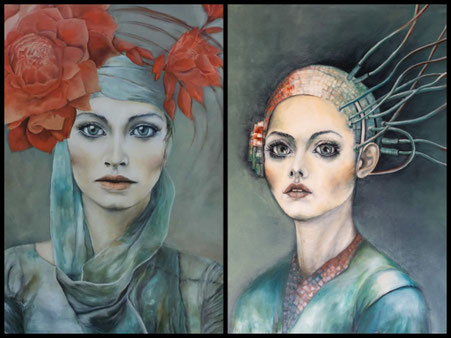

Das Werk thematisiert den Übergang von einer digital geprägten Wahrnehmung hin zu einer erweiterten, vielschichtigen Form von Identität. „Binary Vision“ verweist auf eine Existenz, die von Daten, Codes und technologischen Systemen strukturiert wird. Der Mensch erscheint dabei nicht losgelöst von Technik, sondern als Teil eines kulturellen und gesellschaftlichen Transformationsprozesses.
Mit „Voices of Blossom“ wird diese Ausgangssituation weitergeführt. Die binäre Ordnung wird nicht verworfen, sondern in ein offeneres System überführt. An die Stelle eindeutiger Gegensätze treten Mehrdeutigkeit, individuelle Erfahrung und kollektive Erinnerung.
Im Kontext von „future culture“ untersucht das Werk, wie sich menschliche Wahrnehmung, Kommunikation und Selbstverständnis unter dem Einfluss technologischer Entwicklungen verändern. Es stellt die Frage, ob Zukunft ausschließlich durch Fortschritt, Optimierung und Kontrolle definiert wird – oder ob darin auch Räume für Empfindung, Verletzlichkeit und nicht messbare Formen von Wissen bestehen.
„Voices of Blossom“ markiert damit eine Entwicklung von der codierten Struktur zur pluralen Stimme. Das Werk steht für eine Kultur der Zukunft, in der Technologie nicht isoliert betrachtet wird, sondern in Beziehung zu Körper, Erinnerung, Sprache und sozialer Erfahrung tritt.
The work explores the transition from a digitally shaped perception toward an expanded, multilayered form of identity. Binary Vision refers to an existence structured by data, codes, and technological systems. Human beings do not appear detached from technology, but rather as part of an ongoing cultural and social transformation process.
With Voices of Blossom, this initial situation is further developed. The binary order is not rejected, but transformed into a more open system. Clear oppositions give way to ambiguity, individual experience, and collective memory.
Within the context of future culture, the work investigates how human perception, communication, and self-understanding are changing under the influence of technological developments. It raises the question of whether the future is defined solely by progress, optimization, and control — or whether it also contains spaces for emotion, vulnerability, and forms of knowledge that cannot be measured.
Voices of Blossom thus marks a development from coded structure to plural voice. The work stands for a future culture in which technology is not viewed in isolation, but in relation to body, memory, language, and social experience.
Video Art by Doris Breuer | future culture
Artist & Concept: Doris Breuer
Video Editing & AI Creation: Doris Breuer
Music:
- Anna Reisner
- Peter Pop
- Dietmar Schöller
- Serge Labat
- Andreas Teufelauer
Created for the exhibition future culture, curated by Ulf Dückelmann and Susanna Bihari.
Tech or Touch – “Cybernetic Isolation” transformed into “Cosmic Fusion”
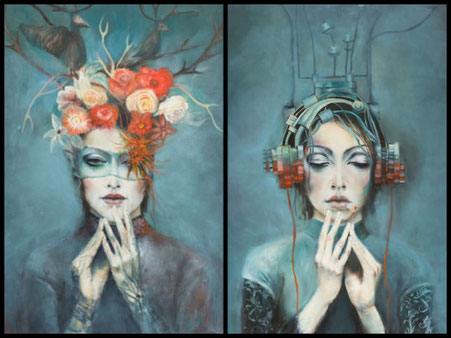
Das Werk thematisiert das Spannungsverhältnis zwischen technologischer Abgrenzung und erweiterter innerer Verbundenheit. „Cybernetic Isolation“ verweist auf einen Zustand, in dem der Mensch von der unmittelbaren Welt getrennt und in technische Systeme eingebunden ist. Isolation wird dabei nicht ausschließlich als Distanz verstanden, sondern als eine durch Schnittstellen, Netzwerke und vermittelte Wahrnehmung geprägte Existenzform.
Mit „Cosmic Fusion“ wird dieser Zustand in ein erweitertes Beziehungsfeld überführt. Das geschlossene System öffnet sich zu einem umfassenderen Verständnis von Verbindung, in dem Technologie nicht als Grenze, sondern als Übergang erscheint. Das Werk reflektiert die Möglichkeit, innere und äußere Räume jenseits physischer Präsenz und direkter Kommunikation zu erschließen.
Im Kontext von „future culture“ untersucht das Werk, wie technologische Umgebungen Wahrnehmung, Bewusstsein und das Erleben von Zugehörigkeit verändern. Es stellt die Frage, ob Trennung durch Technologie zwangsläufig zu Entfremdung führt – oder ob neue Formen von Aufmerksamkeit, Resonanz und erweitertem Vorstellungsraum entstehen können.
The work explores the tension between technological separation and expanded inner connectedness. Cybernetic Isolation refers to a condition in which human beings are detached from the immediate world and integrated into technological systems. Isolation is not understood solely as distance, but as a mode of existence shaped by interfaces, networks, and mediated perception.
With Cosmic Fusion, this condition is transformed into an expanded field of relations. The closed system opens toward a broader understanding of connection, in which technology appears not as a boundary, but as a transition. The work reflects the possibility of accessing inner and outer spaces beyond physical presence and direct communication.
Within the context of future culture, the work investigates how technological environments transform perception, consciousness, and the experience of belonging. It raises the question of whether separation through technology inevitably leads to alienation — or whether new forms of attention, resonance, and expanded imagination can emerge.
“Lines Between Us – Dialogue in the In-Between”
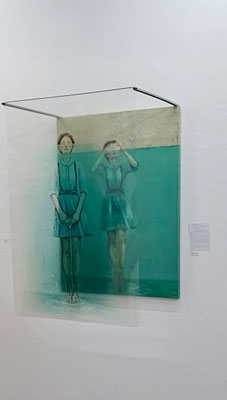
100 x 140 x 80 cm
oil on canvas & & digital AI processing, print on foil
Between transparency and reflection, a contemplative interface unfolds beyond the surface. The glass becomes a membrane in which reality and reflection merge—an attempt to break through the visible.
The installation opens an experimental space for thought, in which questions of perception, materiality, and the shifting of visual meanings are negotiated. At its center lies the encounter of two visual worlds: an oil painting created by me and an AI-generated variation derived from it. These two versions mirror one another, gradually merging. The mirror on the floor expands perception by allowing the viewer to become part of the artwork, enabling a multi-layered reading of the image’s theme.
The painting explores the gaze through the veil of water, through the glasses, into a new dimension. The glass appears as a membrane that both separates and connects. The AI interpretation, however, introduces a transformed gesture: water emerges from the glasses, initiating a process of release, redirection, and dissolution—transparent, intangible.
Central to the work is the question of how transparency and reflection can function as epistemological structures—a threshold where reality, projection, and reflection blend into one another. Perception appears as a fluid interface, unfolding and shifting according to the situation.
Touching interface thus describes not an object, but a state: a fragile field between visibility and its disruption. It marks a transitional place where perception does not become surface but instead reveals itself as an ongoing process of transformation—one that takes shape only through active viewing.
The exhibition “Lines Between Us – Dialogue in the In-Between” explores the tension between separation and connection. Lines—whether painted, written, spoken, or moved—divide and unite at the same time. They mark, touch, and linger. Between them lies a space that is not empty but full of meaning: an in-between space where dialogue can emerge through art, language, body, and sound.
At the center are large-format oil paintings by Doris Breuer, in which painterly intensity weaves
texts, book pages, poetry, and
lines into complex pictorial spaces. Words appear and disappear beneath layers of paint; lines
traverse the surface and give structure to the invisible.
This creates multidimensional works—visual, linguistic, emotional, and conceptual.
The exhibition unfolds as a polyphony of different dimensions—not only through artistic
disciplines such as painting, textile art, installation, music, and dance, but also as an invitation to
individual perception.
What appears visible at first glance reveals deeper layers upon closer observation. Texts emerge, fall silent, are painted over. Movements
respond to stillness. Sounds tell of the unseen.
Each visitor enters their own dimension of experience, shaped by inner resonance,
personal interpretation, and physical presence in the space.
The performance expands this perception: it shifts boundaries between language and movement, between the visible and the hidden. A central figure, the “Unreadable,” represents the unspoken and concealed; she looks into another dimension where language is not spoken but felt.
In this way, the project becomes an artistic reflection on the visible and what lies between the lines. What can be read? What can be felt? What remains hidden? And how can art open pathways to other dimensions of meaning?
Zwischen Transparenz und Reflexion entfaltet sich eine kontemplative Schnittstelle jenseits der Ober-fläche. Das Glas wird zur Membran, in der Realität und Spiegelung ineinander übergehen, ein Versuch, das Sichtbare zu durchbrechen.
Die Installation eröffnet einen experimentellen Denkraum, in dem Fragen nach Wahrnehmung, Materialität und der Verschiebung visueller Bedeutungen verhandelt werden. Im Zentrum steht die Begegnung zweier Bildwelten: eines von mir mit Öl gemalten Werkes und einer aus diesem Werk KI-generierten Variante. Diese beiden Versionen sind eine Spiegelung, die ineinander übergehen. Der Spiegel am Boden erweitert die Wahrnehmung, indem er den Betrachter zu einem Teil des Kunstwerkes werden lässt und so eine vielschichtige Lesart des Bildthemas ermöglicht.
Das Gemälde thematisiert den Blick durch den Schleier des Wassers, durch die Gläser, in eine neue Dimension. Das Glas erscheint als Membran, die sowohl trennt als auch verbindet. Die KI-Interpretation hingegen führt eine transformierte Geste ein: Aus den Gläsern tritt Wasser aus und setzt einen Prozess des Loslassens, der Umlenkung und der Entgrenzung in Gang – durchsichtig, nicht greifbar.
Zentral ist die Frage, wie Transparenz und Spiegelung als epistemologische Strukturen wirken können; als Schwelle, an der Realität, Projektion und Reflexion ineinander übergehen. Wahrnehmung erscheint als bewegliche Schnittstelle, die sich situativ entfaltet und verändert.