
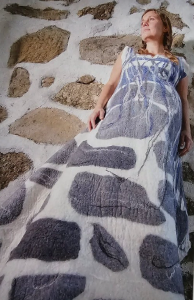
In this body of work, the traditional Steinbloß house of the Mühlviertel region stands as a symbol of stability, grounding, and a centuries-shaped cultural
landscape.
The depicted woman merges with this archaic architectural form and becomes a carrier of cultural history herself. Her figure does
not appear as a contrast to the landscape but as its extension—an organism rooted in the land while simultaneously embodying its transformation.
The transformation of material plays a central role: dense, heavy matter changes through warmth, movement, and manual processing into a protective skin. This process highlights the transitions between hardness and softness, resistance and permeability.
Fine, translucent felts form fragile shells that can be read as symbols of
inner freedom, vulnerability, and the capacity for openness.
In their interplay, a field of tension emerges between groundedness and lightness, between cultural depth and individual self-assertion.
These works explore how body, landscape, and traditional architectural forms enter into dialogue—and how identity takes shape within the interaction of material, place, and movement.