visible - Non violent living environments for women
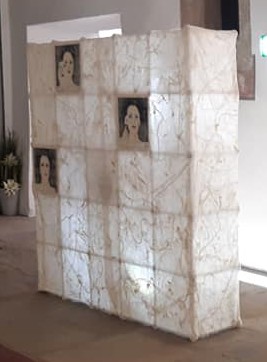
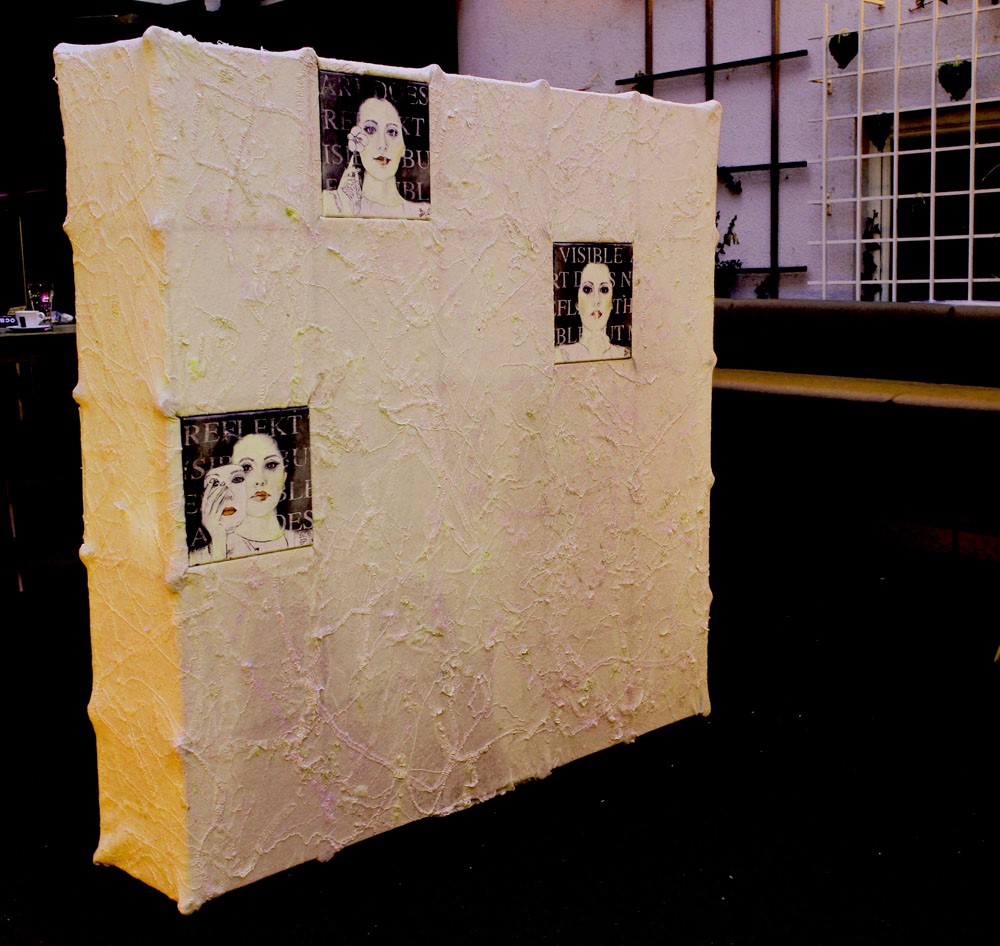
”Visible” is a cube measuring 1.80 × 1.80 meters with a depth of 0.36 meters, wrapped in white felt. Silk and lace embedded in the felt lend the object a feminine delicacy and lightness. The tactile encounter with the surface is soft and warm. Felt signifies interconnectedness; it is a symbol of security and support. On the front of the object, three paintings (oil on canvas) are inserted. They show portraits of women whose faces depict moments related to the theme of violence: the silent woman, the woman who removes her mask, and the woman who has regained her strength. The canvases are wrapped in transparent silk printed with text via screen printing. The silk acts as a membrane between inside and outside—interrupted by words that break the silence.
“Visible” resembles a white wall, yet it has lost its function as a boundary between inside and outside. This wall is not a piece of the room but a piece within the room. It allows viewers to look behind the façade, to enter into it.
The felt surface on the back does not appear as immaculate as on the front. Being a woman also means not being flawless. Here, the mask of intactness falls away. A black line with small, colorful felt dots running diagonally across the entire surface depicts police crime statistics on femicides from 2014 to 2018. Every three centimeters marks one murder. The last dot signifies 41 women killed.
Slit-like openings are cut into the felt. They invite viewers to explore the object and discover the “spaces” behind it. These cuts not only pierce the enveloping felt structure but also interrupt the femicide statistics. Breakthrough, emergence, discovering something new.
Hannah Arendt once wrote that things only become real when they become visible and audible in the public sphere (vita activa). In accordance with this insight, we want not only the experiences of violence endured by women to be seen in all their facets, but also the many strategies that can lead out of such situations to be brought to light. This is realized through the interaction between viewers and the object.
“Visible” invites its viewers to submit their own personal experiences anonymously. A mailbox is provided for this purpose in the “Experience Room.” These accounts, processed as text and image, will appear at the next exhibition site, where they will become visible. Through interaction, the object becomes a process—its journey through public space is transformed by the stories it receives.
These reports are collected on the homepage, Instagram, and Facebook. In this way, not only a physical but also a digital public sphere is created, in which women can share their stories.
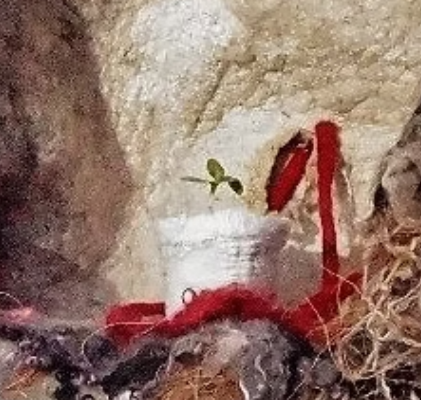
In the “Shelter Room,” there is a cave-like felt structure that fills the space, inside which a small seedling stands. A symbol of protection, rootedness, hope, and new beginnings. The encompassing presence of the interwoven felt structure represents the protection that arises through being embedded in social relationships and through connection to the outside world. Leaflets from women’s protection centers, placed in a small felt pocket on the inside of the door, provide further information and support.

In the two “language rooms,” experience reports from women who have lived through situations of violence are printed on transparent plastic. Black on white, honest, unfiltered, and deeply moving. Each story is a breakthrough into the light. The first accounts come from women in our women’s groups—powerful women. To be seen and heard is healing.

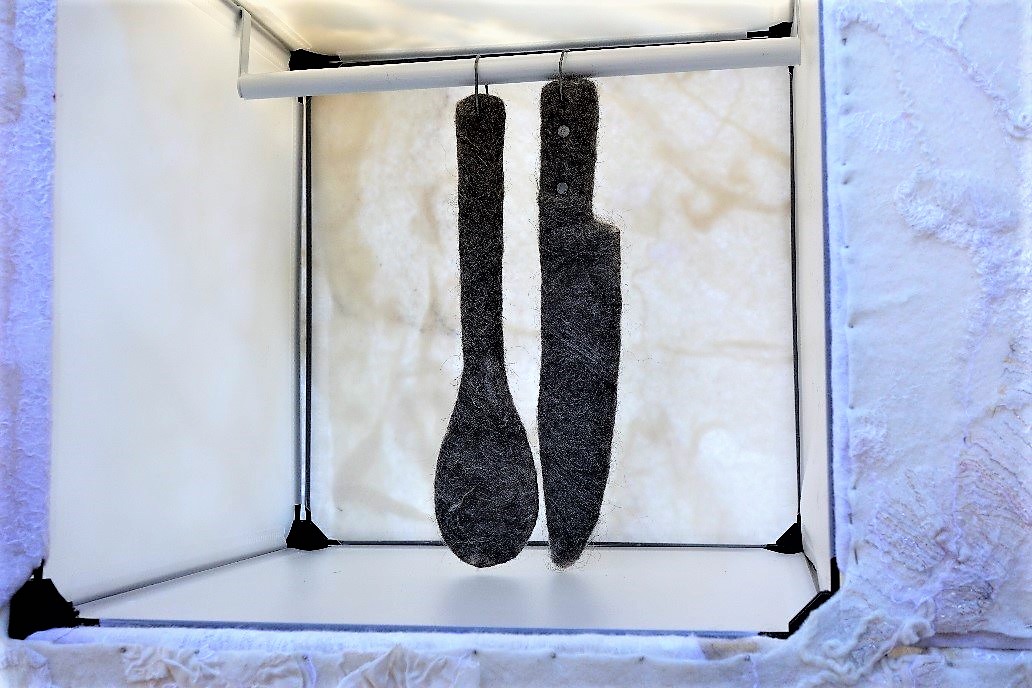
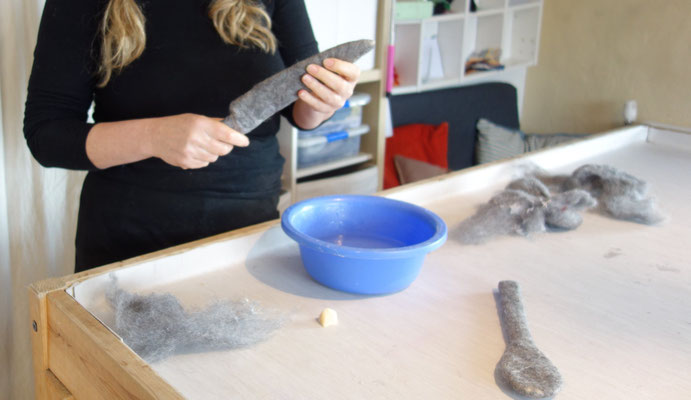
In the “Room of Invisibility,” felt-covered kitchen tools—a wooden spoon and a knife—refer to domestic work, of which women still perform twice as much as men. Work that remains unseen. Just like much of the violence against women, it takes place in private. The felting of the tools underscores this hiddenness: grey on white, dark, invisible. The kitchen knife, often used as a weapon in femicides, serves as an additional reference to the rising number of women murdered in Austria.